
Jones County Court Records After Arrest
A Jones County jail arrest starts with booking at the Adult Detention Facility or, for juvenile custody, the separate Juvenile Detention Facility. The booking record is useful, but it is not the final court record. The roster can list the charge words used at intake, the arresting agency, booking number, booking date, and bond amount. After that point, the prosecutor reviews the file and decides what charge or charges should be pursued in court.
For felony matters in Jones County, the District Attorney for Mississippi Circuit Court District 18 is the key prosecution office. The official Attorney General circuit map identifies Brad Thompson as District Attorney for District 18, covering Jones County, with phone 601-649-4606. Under Sheriff Joe Berlin, the sheriff's Court Services Division also sits in this path because it serves court papers and indictments, locates most-wanted subjects, and transports arrested people to ADF or JDF.
The roster remains a strong starting point. It can give a name spelling, booking number, arresting agency, and charge clue. For the custody side, use Jones County jail inmate records. For booking photos, use Jones County jail mugshots. The court record is a different file: it is the complaint, information, indictment, docket entries, orders, bond changes, and disposition tied to the criminal case.
Find Jones County Court Records
Mississippi Electronic Courts lists Jones County Circuit Court as a participating court under "Jones County Circuit Court - (CIRCUIT & COUNTY)." MEC is the official online court-record path where public access is available for many circuit and county criminal records. Access can depend on the case type, public access rules, and account terms, so the portal should be treated as the online starting point rather than a promise that every record will be visible.
The Circuit Clerk is the fallback when MEC does not show the file, when a copy is needed, or when older or restricted records require clerk handling. The research source notes that the Circuit Clerk maintains County, Youth, Civil, and Criminal Court records, the judgment roll, and other court documents. For sheriff records, use a public-records request to the sheriff or detention facility. For court filings, use MEC or the clerk process.
| Field | How It Helps | Jones County Note |
|---|---|---|
| Court or county | Selects the court system to search. | Use Jones County Circuit Court where MEC offers it. |
| Party name | Finds cases when the case number is unknown. | Match roster name spelling when possible. |
| Case number | Finds the exact docket. | Ask ADF staff or the clerk if the roster lacks it. |
| Login or access | Controls public or registered-user access. | Availability may vary by record and user type. |
The Mississippi Electronic Courts page is the source shown below for Jones County case lookup context.
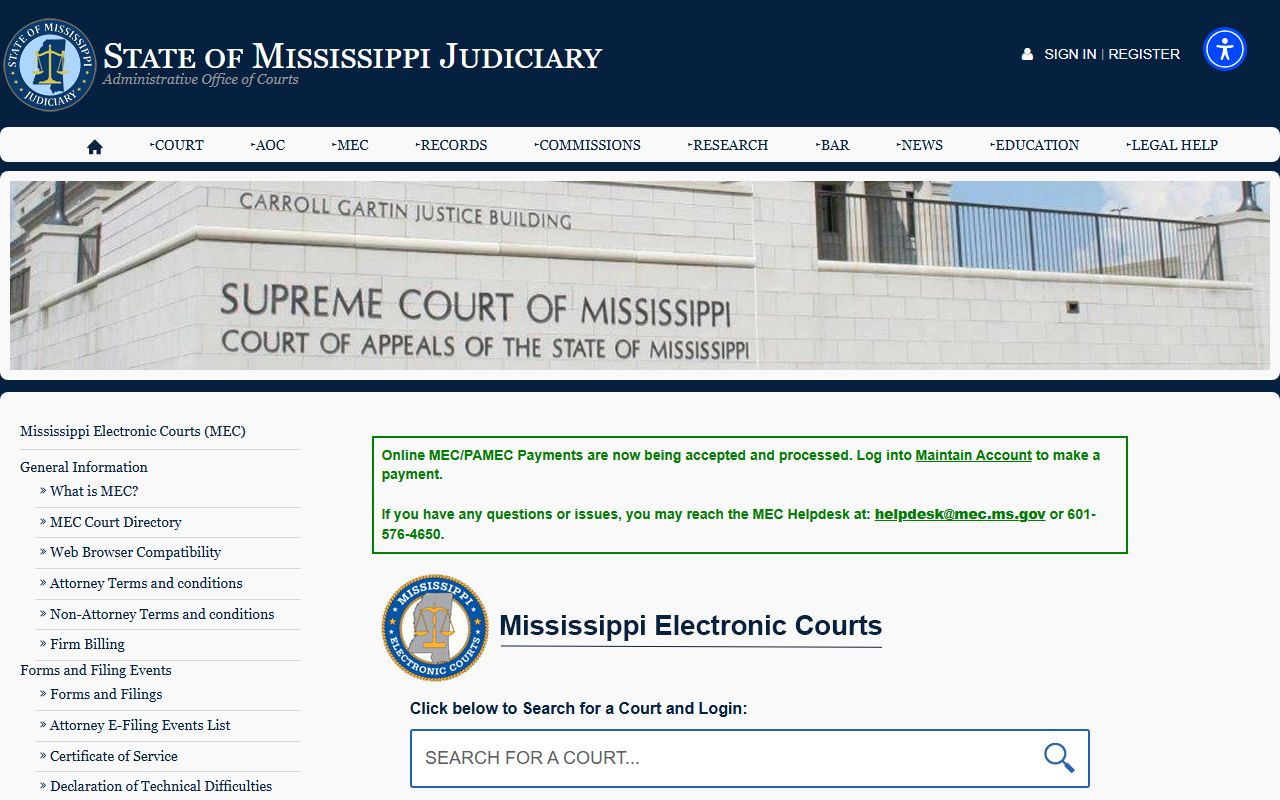
MEC helps bridge the gap between a jail booking clue and the court file, but clerk confirmation is still important when charge status or copies matter.
Use Roster Clues for Cases
The Jones County current roster and 48-hour release roster are not court dockets, yet they give practical clues for finding court records after an arrest. The current roster can show a mugshot, name, booking number, age, booking date, charge list, bond amount, and profile link. A profile can show the arresting agency, gender, race, booking date, and charge list. Those fields help narrow a MEC or clerk search when the court case number is not known.
- Copy the name exactly as it appears on the Jones County roster.
- Note the booking date, arresting agency, and booking number.
- Record each listed charge, but treat it as an intake clue.
- Search MEC by party name or ask the clerk about the case number.
- Call ADF at 601-649-7502 before relying on a bond or charge line.
The sheriff's profile warning is important. Charges and bail amounts may change after court appearances, and bond companies or people posting bail should contact Detention Center staff for the correct bail amount, charges, and case numbers. A roster bond line can be stale after a first appearance, indictment, amendment, hold, or court order.
Jones County Charging Documents
Court records after a jail arrest take shape through a charging document. A complaint may start a lower-court or early criminal matter. An information is a prosecutor-filed charge document. An indictment is returned by a grand jury and is common in felony practice. Jones County research did not locate a local public table of forms, so these terms should be read as plain criminal-case categories rather than a promise that every case uses the same route.
| Document | Who Starts It | What It Means |
|---|---|---|
| Complaint | Officer, court, or prosecutor process | Begins an accusation or lower-court charge after an arrest. |
| Information | Prosecutor | States the charge the prosecutor files without relying on the roster wording alone. |
| Indictment | Grand jury | Formal felony charge document served through the court process. |
The sheriff's Court Services Division specifically mentions serving court papers and indictments, locating and arresting most-wanted subjects, and transporting prisoners. That local role matters because a person may move from a jail roster entry to an indictment, warrant, or court appearance before the public-facing court record looks complete.
Jones County Charge Status
Charge status tells the reader what has happened to a count in court. A booking charge can be pending while the case is new. It can be amended when the prosecutor or court changes wording. It can be reduced to a lesser offense. It can be dismissed, or the prosecutor may enter nolle prosequi, which means the state is not proceeding on that count. None of those terms should be read from the roster alone.
| Status | Plain Meaning | Why It Matters After Arrest |
|---|---|---|
| Pending | The charge is unresolved. | The court case is still active or waiting for the next step. |
| Amended | The filed charge changed. | The docket may no longer match the first roster wording. |
| Reduced | A lesser charge replaced or narrowed the original charge. | Bond, plea talks, and sentencing exposure can change. |
| Dismissed | The court or prosecutor ended that count. | The arrest may still exist unless sealed or expunged. |
| Nolle prosequi | The prosecutor declines to proceed. | The count is not being pursued in that case posture. |
| Conviction | Guilt was adjudicated by plea or verdict. | This is different from a mere arrest or filed charge. |
Bond After Jones County Arrest
Bond is one of the easiest details to misunderstand after a Jones County arrest. The roster may show a dollar amount or a zero-dollar line. A zero-dollar line does not always mean free release. The same roster can show holds such as MDOC HOLD or HOLD FOR OTHER AGENCY, and those holds can block release even when one charge line looks bondable.
| Bond Situation | Meaning | Jones County Caution |
|---|---|---|
| Cash bond | Payment of a court-set amount. | Confirm the exact amount with ADF before paying. |
| Surety bond | Bond through a licensed bail agent. | Bond companies should call ADF for current charges and case numbers. |
| Personal recognizance | Release based on a promise to appear. | Availability depends on court order, not the roster alone. |
| No-bond or hold | Release is blocked or limited. | Ask about warrants, detainers, MDOC holds, and outside agency holds. |
Mississippi court events can alter bond after the first roster entry. A first appearance, new warrant, indictment, amended charge, or detainer can change what is needed for release. The most reliable Jones County action is to call the Adult Detention Facility at 601-649-7502 and ask for the current bail amount, charges, and case numbers before money changes hands.
Jones County Warrants After Arrest
Jones County has an official Wanted section behind a disclaimer, but the research did not locate a complete searchable active-warrant database. A June 16, 2025 sheriff press release said several people were added to the wanted list and that the vast majority were wanted on outstanding bench warrants. That means the public wanted page is selective. It is not a full warrant clearance tool.
Bench warrants can come from Justice Court, Municipal Court, County Court, or Circuit Court depending on the case. The sheriff's Court Services Division works with court papers, indictments, wanted subjects, and prisoner transport. A person arrested on a warrant may later appear on the ADF roster with language such as BENCH WARRANT, JUSTICE COURT WARRANT, WARRANT (FELONY), or HOLD FOR OTHER AGENCY. Resolving a warrant should go through the issuing court, counsel, or the responsible agency because a walk-in can result in arrest.
Charges, Convictions, and Expunction
A charge is an accusation. A conviction is an adjudicated result by plea or verdict. Court records after a jail arrest can contain both, but they should never be treated as the same fact. Mississippi public-record rules allow access to many public records unless a law limits disclosure, while sealed, juvenile, investigative, medical, mental-health, and expunged material may be restricted.
| Record Type | What It Shows | What It Does Not Prove |
|---|---|---|
| Charge | An accusation filed or listed in a case. | It does not prove guilt. |
| Conviction | A guilty plea, verdict, or adjudicated result. | It does not show every arrest that did not lead to conviction. |
Mississippi expunction law, including Miss. Code Section 99-19-71, covers eligible arrests and cases. The research did not find a Jones County promise that an online booking image or third-party copy disappears automatically after expunction. Court orders and agency handling control the official record.
| Action | Public Visibility | Jones County Search Effect |
|---|---|---|
| Sealed | Hidden or limited for public viewing. | MEC or clerk access may be blocked or narrowed. |
| Expunged | Eligible record is cleared under court order. | Official arrest or case access may change after processing. |
Jones County Public Access Limits
Mississippi's Public Records Act supports inspection of public records unless another law provides an exception. Miss. Code Section 25-61-1 states the general policy. Section 25-61-3 defines public records, incident reports, and investigative reports. The Mississippi Ethics Commission notes that law-enforcement incident reports are public records, while victim identity need not be disclosed.
Response time and fees also matter. Section 25-61-5 addresses response timing, with procedures not allowing production or denial later than seven working days under the current text. Section 25-61-7 allows fees for costs incident to providing records. Juvenile records, sealed files, active investigative material, victim-identifying details, and mental-health related records can be treated differently.
Important: Do not use jail, court, or roster data for employment, tenant, credit, insurance, or other FCRA-covered screening.